Drain Descaling vs Hydro Jetting: What's the Difference?
Hydro jetting washes out grease and roots. Descaling grinds rust scale off old cast iron. Which one your drain needs, LA and OC costs, and when to line it.
Hydro jetting and descaling both clean the inside of a drain, but they remove different things. Hydro jetting sprays water at high pressure to wash out soft buildup: grease, sludge, soap, sand, and tree roots. Descaling spins chains on a cable to grind hard rust scale off the walls of old cast iron pipe. If the problem is stuck inside the pipe, jetting usually clears it. If the pipe wall itself has grown a crust of rust, it needs descaling, usually followed by a rinse with a jetter.
Neither one fixes a pipe that is cracked, broken, or rusted through. For that, the usual answer is a liner (a new pipe formed inside the old one) or a replacement. Here's how to tell which one your drain needs, what each costs in LA and Orange County, and what to ask before you pay.
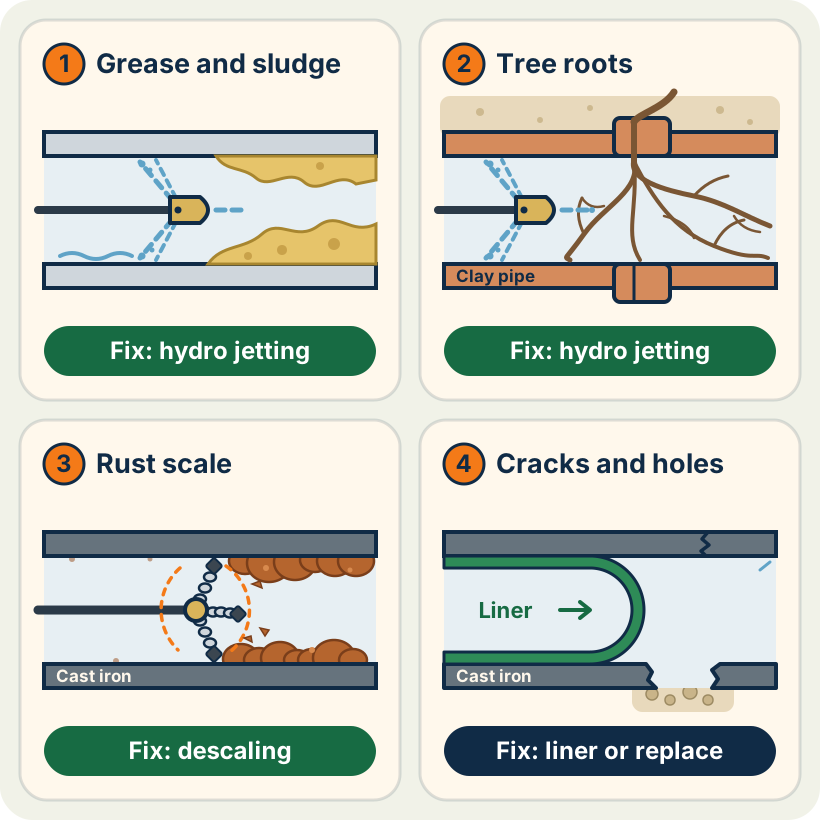
Descaling vs Hydro Jetting at a Glance
| Question | Hydro jetting | Descaling |
|---|---|---|
| What does the work? | Water at high pressure through a hose and nozzle | Spinning chains on a flexible cable |
| What does it remove? | Grease, sludge, soap, sand, tree roots | Rust scale and other hard deposits on the pipe wall |
| Where is it used most? | Kitchen lines and sewer lines, including clay pipe with roots | Old cast iron drains and sewer lines |
| What can't it do? | Grind off heavy rust scale | Wash debris out by itself, so a rinse follows |
| Typical cost in LA and OC | $350 to $800 for a home line | No price listed yet (see below) |
| Is a camera needed first? | Yes | Yes |
What Is Hydro Jetting?
A plumber feeds a high-pressure hose into the drain, usually through a cleanout. The nozzle on the end has small holes. Some point forward to cut through the clog. Others point back at an angle, which pulls the hose up the pipe and scours the walls as it goes. The water carries the loosened grease and debris down the line to the sewer.
Pressure and flow depend on the machine and the pipe. For a 4-inch home sewer with roots, a veteran jetting contractor writing in Cleaner magazine recommends at least 4 gallons per minute at 4,000 psi, or 5.5 gallons per minute at 3,500 psi, with the right nozzle (Cleaner). Smaller lines inside the house get smaller settings.
Hydro jetting works best on:
- Grease and food sludge in kitchen lines.
- Soap scum and hair in bathroom lines.
- Sand, silt, and mud that settle in the bottom of the pipe.
- Tree roots in sewer lines, with a nozzle made for cutting roots. Jetting clears the roots, but it doesn't seal the crack or joint they came through, so they grow back.
What it doesn't do well is remove heavy rust scale from cast iron. A how-to guide on cleaning pipe before lining, published in Cleaner magazine, recommends jetting cast iron first to clear the debris, then a mechanical spinning head to descale the walls (Cleaner).
What Is Drain Descaling?
Descaling is mechanical cleaning. A plumber runs a flexible shaft into the pipe with a chain head on the end. The machine spins it fast, the chains open up to the pipe wall, and they grind off rust, scale, and other hard deposits. Some chain heads have a drill tip on the front for pushing through roots and hard blockages first (Cleaner, MSW). Then the line is rinsed, usually with a jetter, and checked with a camera.
Cast iron is the pipe that needs it most. It rusts from the inside, and over decades lumps of rust (plumbers call it tuberculation) build up on the walls and narrow the pipe. The rough surface catches grease and paper, so the same drain clogs again and again. A house built before 1970 most likely has cast iron drains under the foundation (Noozhawk).
Descaling is also the usual first step before a pipe is lined. A liner needs a clean wall, and lining systems have to be installed in pipe that has been inspected and cleaned (ICC-ES PMG-1546).
One thing to know before you start: in very old cast iron, the scale can hide how thin the wall has become. Once it's gone, the camera may show holes or cracks that were there all along (Arrow Sewer & Drain). That can turn a cleaning job into a repair job, so ask the plumber what happens if they find damage.
Which One Does Your Drain Need?
Go through these in order. The camera answers most of the questions, so don't skip step 1.
1Has anyone run a camera through the line?
Yes: Ask to see the video. It shows what the pipe is made of, what's inside it, and whether it's still in one piece. Go to check 2.
No: Start there. In the City of Los Angeles, LA Sanitation offers a rebate of up to $300 toward a sewer lateral video inspection while funds last.
2Grease, sludge, or soft buildup coating the pipe?
Yes: Hydro jetting. It cleans the walls instead of just poking a hole through the clog.
No: Go to check 3.
3Tree roots in the line?
Yes: Hydro jetting with a root-cutting nozzle, or a cable with a cutting blade. If the roots come back every year or two, ask about lining or repairing that section.
No: Go to check 4.
4Cast iron with lumps of rust narrowing the pipe?
Yes: Descaling, then a rinse and a second camera run to see the wall underneath.
No: Go to check 5.
5Cracks, holes, broken joints, or a rusted-out bottom?
Yes: Cleaning won't fix it. Ask about a liner or a replacement. See when cleaning isn't enough below.
No: Ask the plumber what the video does show before you pay for any method.
Are Jetting and Descaling Safe for Old Pipes?
On pipe that's still sound, yes. The risk is pipe that's already failing: cast iron rusted thin, clay pipe with separated joints, or Orangeburg (a fiber pipe used in some mid-century homes). High-pressure water can make that damage worse, and a camera inspection is what shows whether jetting is the right method at all (Arrow Sewer & Drain). Descaling chains can do the same to a pipe that's barely holding together.
That's why the camera comes first. Ask the plumber:
- What is the pipe made of, and where does it change?
- What pressure, nozzle, or chain will you use, and why?
- Will you run the camera again after cleaning?
Why LA and Orange County Homes Often Need Both
It's common for an older house to have cast iron under the floor that changes to clay pipe outside, on its way to the street (Trenchless Technology). So one sewer line can need descaling under the house and root cleaning in the yard.
You own that pipe, usually all the way to the street:
- City of Los Angeles: Property owners are responsible for the whole private sewer lateral, from the building to the connection in the street. Work under the sidewalk or street needs a permit from the Bureau of Engineering (LA Sanitation).
- LA County sewer districts: The owner is responsible for the entire lateral, including the part under the street (LA County Public Works).
- Long Beach: The owner maintains both sections of the lateral (Long Beach Utilities).
- Fullerton: The owner is responsible for the entire length, including the part under the street (City of Fullerton).
Rules differ by city, so check yours. LA Sanitation says tree roots and grease together cause more than half of sewer backups. City of LA sewer customers can apply for a rebate of up to $300 for a lateral video inspection and up to $2,500 for a lateral repair, first come, first served, while the year's funds last (LA Sanitation).
What Each Costs in LA and Orange County
These are typical estimated ranges for licensed plumbers in LA and Orange County. They are not quotes.
| Service | Typical estimated range |
|---|---|
| Sewer camera inspection | $125 to $350 |
| Snaking the main sewer line (cleanout to street) | $200 to $500 |
| Hydro jetting a home drain line (up to 4 inch pipe) | $350 to $800 |
| Hydro jetting the full main sewer line, house to street | $400 to $900 |
| Adding a sewer cleanout so the line can be reached | $650 to $4,000 |
| Lining a short section of drain or sewer pipe (about 20 to 40 feet) | $3,000 to $8,000 |
| Digging up and replacing one damaged section | $1,500 to $4,500 |
| Replacing the sewer line by pipe bursting | $5,000 to $13,000 |
| Replacing the whole sewer line | $4,000 to $15,000 |
Lining prices vary the most. Length, pipe size, the number of access points, and whether the line has to be descaled first all change the price, so get the scope in writing. Some plumbers include the camera inspection with jetting, so ask before you pay for it separately.
Questions to Ask Before You Pay
- Can I see the camera video and keep a copy?
- What's causing the problem: grease, roots, scale, or a broken pipe?
- Why this method, and not the other one?
- How many feet will you clean, and from which cleanout?
- Is the after-cleaning camera run included?
- Is this likely to come back, and when?
- Are you licensed? You can check any California contractor's license in a few seconds.
When Cleaning Isn't Enough: Pipe Liners
If the camera shows cracks, holes, joints that have pulled apart, roots coming through broken pipe, or cast iron rusted through at the bottom, cleaning won't fix it. Jetting or descaling can get water flowing again for a while, but the damage stays. That's when a plumber may recommend a liner.
What a liner is. A cured-in-place pipe (CIPP) liner is a flexible tube soaked in resin. It's pulled or turned inside out into the old pipe, pressed against the walls, and hardened, often with hot water, steam, or UV light. The result is a new pipe inside the old one, put in through a cleanout or a small access point instead of a trench (Trenchless Technology, NASSCO). Many drain liners use epoxy resin (ICC-ES PMG-1203).When a Liner Won't Work
A liner follows the old pipe, so it can't fix every problem:
- A collapsed pipe. There's nothing for the liner to follow. If a pipe is partly collapsed and cleaning it might finish the job, pipe bursting is usually the better choice (Plumber magazine).
- A belly, which is a sag in the line that holds water. Lining through it won't fix the sag or the slope (City of Saint Paul).
- Joints that have shifted badly out of line.
In those cases the choices are pipe bursting, which pulls a new pipe through while breaking the old one apart, or digging up and replacing the bad section.
Permits and Inspection
The 2025 California Plumbing Code allows trenchless lining of building sewers where the local building department permits it, following standards such as ASTM F1216 (Section 715.3). Cities set the details. Yorba Linda, for example, has a building inspector watch a live camera inspection of the whole lined line before signing off the plumbing permit (City of Yorba Linda). Listing reports for lining systems also call for a final video inspection witnessed by the inspector (ICC-ES PMG-1546). Ask who pulls the permit, and ask for the before and after videos.
Is Epoxy Lining Still Used?
Yes, for drains and sewers. Epoxy liners are a common trenchless repair, and lining systems are listed by ICC-ES for current codes, including the 2025 California Plumbing Code and the Los Angeles Plumbing Code (ICC-ES PMG-1546). Coating drinking water pipes with epoxy is a separate decision. Researchers at Purdue University have found chemicals leaching from new epoxy liners into drinking water, so get that question answered on its own if a plumber suggests it for your water lines (Purdue University).
A short lined section typically runs $3,000 to $8,000.
Not sure what your drain needs? Describe the problem or upload a photo on our homepage for a free AI diagnosis, and ask any plumber you hire to show you the camera video before the work starts. Facts checked November 8, 2026.
Frequently Asked Questions
Is hydro jetting better than snaking?
For grease, sludge, and roots, usually. A snake punches a hole through the clog, while a jetter cleans the pipe walls, so the clog is less likely to come right back. Snaking is cheaper and fine for a simple clog. Jetting costs more and needs a sound pipe.
Can hydro jetting damage cast iron pipes?
It can if the cast iron is already rusted thin or cracked. On sound pipe at the right pressure, it's a normal cleaning method. That's why a camera inspection should come before jetting old pipe.
Does descaling remove tree roots?
Yes. Descaling chains and drill heads cut through roots as well as rust. Like jetting, though, they don't seal the joint the roots came through, so roots can grow back.
How do I know if my drain pipes are cast iron?
Look where the drain leaves the house, in a crawl space, or at a cleanout. Cast iron is heavy, dark gray or black metal, often rusty. A camera inspection will show it for sure, along with where it changes to clay or plastic.
Will a liner stop roots from coming back?
In the lined section, usually. A cured-in-place liner forms a pipe with no joints inside the old one, which takes away the gaps roots grow through. Roots can still get in through any section that isn't lined.
Who pays to clean the sewer line under the street?
In the City of Los Angeles, LA County sewer districts, Long Beach, and Fullerton, the property owner is responsible for the whole lateral, including the part under the street. Rules differ by city, so check with yours.
Is epoxy pipe lining still recommended?
For drains and sewers, epoxy liners are still widely used and are listed for current California codes. Coating drinking water pipes with epoxy is a separate question, with research showing chemicals can leach from new liners, so weigh it on its own.
Sources (23)
- Cleaner magazine: Picking the right jetter
- Cleaner magazine: A how-to guide on pipe cleaning before CIPP rehabilitation (sponsored by Nu Flow)
- Cleaner magazine: Drill chains for descaling
- MSW magazine: Chains and coating system for cable machines
- Noozhawk: Cast iron drain pipes under older homes
- Trenchless Technology: Lateral CIPP case, cast iron to clay
- Trenchless Technology: CIPP lining and brush coating inside buildings (September 2023)
- Arrow Sewer & Drain: Is hydro jetting bad for my pipes?
- LA Sanitation: Managing and protecting LA's underground sewer system
- LA Sanitation: Sewer lateral rebates
- LA County Public Works: Sewer maintenance customer information
- Long Beach Utilities: Sewer
- City of Fullerton: Homeowner responsibility for sewer laterals
- NASSCO: Technologies defined in the pipe rehabilitation matrix (2025)
- NASTT: Pipe coating system for 1 1/4 to 6 inch pipe
- ICC-ES PMG-1203: Epoxy cured-in-place pipe liner listing
- ICC-ES PMG-1546: Cured-in-place pipe system listing (2025 CPC, Los Angeles Plumbing Code)
- 2025 California Plumbing Code, Section 715.3: Existing sewers
- City of Yorba Linda: Procedure 008, sewer pipe liner systems
- City of Saint Paul: CIPP lining and belly acknowledgment form
- Plumber magazine: Choosing between pipe bursting and CIPP lining
- City of Tulsa: Cured-in-place pipe specification
- Purdue University: Drinking water quality impacts of epoxy CIPP lining (AWWA 2024)
Not sure what you are looking at?
Upload a photo or video of the problem and get a likely diagnosis with a cost range in your area, before you call anyone.
Free. We're a referral service, not a plumbing company. Photos and videos are read by AI and not stored. Costs are estimates, not quotes. Terms
Common problems
Smell gas or water spreading? Get the safety steps first
- Free to use
- No pressure to hire
- Local cost estimates
Related Articles
Your Sewer Backed Up. Here Is What Is Happening and What to Do.
Sewage coming up through a floor drain, tub, or toilet? What to do first, who is responsible for which pipe, and typical repair cost ranges.
How Much Does Drain Cleaning Cost in Southern California?
Typical estimated costs to clear a clogged drain in LA and Orange County, from snaking one sink to hydro jetting the main sewer line.
Huntington Beach Sewer Easements: What Homeowners Should Know
OC San is clearing a 1959 sewer easement under Rhone Lane backyards. How sewer easements and laterals work for Huntington Beach homeowners.